Wednesday, September 28, 2011

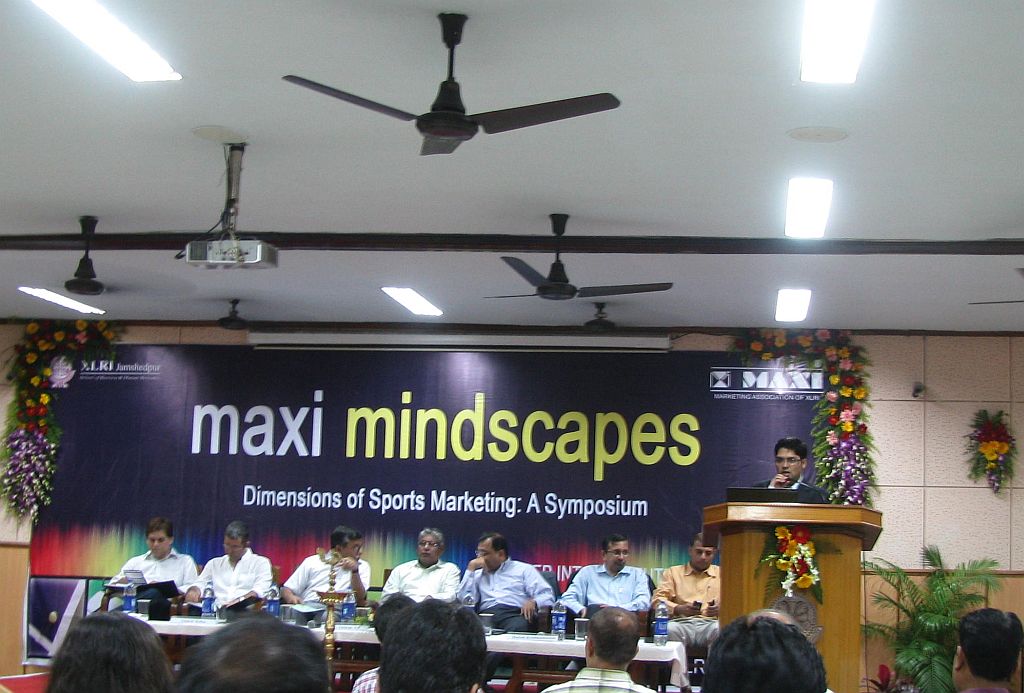
XLRI holds Sports Marketing Symposium

XLRI Jamshedpur (Sept 27th, 2011): The Marketing Association at XLRI (MAXI) hosted industry veterans from the area of sports management and sports marketing on occasion of the second edition of MAXI Mindscapes. The symposium which was aptly titled “Dimensions of Sports Marketing” provided tremendous insight into this very nascent field of sports marketing. Not only were the discussions insightful, but they also aided the students’ understanding of the field which was previous considered to be esoteric business.

Former Indian athlete and Arjuna awardee Charles Borromeo graced the occasion by his presence. The winner of the 800m gold at the 1982 Asiad, Borromeo, who now works with the Tata Sports Foundation was a keen listener throughout and lauded the efforts of sports marketers in promoting and patronizing Indian sportspersons.

Mr. Adille Sumariwalla, an Arjuna awardee himself and the working President of the Athletics Federation of India, took to the stage to begin the proceedings. He spoke distinctly about athletics, swimming and gymnastics being the “mother sports” for all other sports and urged the corporates to do more towards these sports.

Mr.Harish Krishnamachar, Senior VP, World Sports Group and an XL alumnus, spoke about the changing sporting landscapes and new business models emanating out of Asia. He stressed on the need for sports marketing firms to become business or ownership partners with federations, events and venues. Mr.Tarun Chaudhari, Group Director – Sports Marketing at Innocean Worldwide spoke very eloquently about the mismatch between a brand’s expectation out of a sport and vice-versa.

The panel also had a very familiar face in Mr.Gauraav Kalra – the Sports Editor at CNN-IBN. Gaurav looked at the business of sports from the perspective of the media as a whole. He very strongly stated that sport needed to understand the role of television in this modern era, and that television has always been receptive to a great sporting idea. Mr.Chandradeep Mitra, an IIMC alumnus and CEO of Pipalmajik provided an academician’s view on the emerging topic. Chandradeep narrated his experiences about teaching sports management as a formal subject in school across the country. At the same time, he emphasized the need for literature, systems and processes pertaining to sports management.

Chandradeep then moderated a very healthy panel discussion which followed a quick break for tea. The discussion mainly revolved around building and developing sporting properties and models suited for television consumption. Some big, brave bets were made on the scope and possibilities of sports marketing on the whole. The panel also answered a lot of questions thrown at them by the audience with consummate ease and eloquence. The whole discussion was interspersed with a fair bit of wit and humour – all in all a very invigorating experience.

The first ever MAXI Mindscape Symposium resulted in the formation of the interdisciplinary behavioural lab at XLRI. What is the future of sports marketing at XLRI? We’re waiting with bated breath!

Saturday, September 24, 2011

Prof Ram Kumar Kakani (XLRI) co-authors book on Strategic Thinking

Strategic Thinking: Explorations around Conflict and Cooperation.
Saha, Biswatosh and Parthasarathi Banerjee and Ram Kumar Kakani
Sage Publications, Sept. 2011,
ISBN: 978-8-13-210690-6

Strategic Thinking is an exploration of the world of strategic action centered on the strategist actor who remains immersed in the multi-faceted conflicts and contests of the pragmatic life of business. This book explores the various modes through which nodes of power holders are formed or decimated in the organization. It embraces the twin dimensions of strategic motives-deterrence and novel market making-around the theme of governance, without conflating the differences between these differing motives riding on differing dynamics of decreasing and increasing returns.


Dr. Ram Kumar Kakani B. Tech (Andhra Univ.), Fellow (IIM Calcutta) is an Associate Professor of Finance & Strategic Management Area, XLRI Jamshedpur, India. He has worked with industry and was a residential scholar at Copenhagen Business School Denmark, Singapore, & U.A.E. He has authored and co-authored ten management books.

XLRI eyes sporty career

Sept 24, 2011 (The Telegraph): No, it’s not all play, but taking up sports marketing management as a career can seem like it. Especially when you get paid for a job that involves professionally managing the careers of idols, ranging from a Sachin to a Saina.

Sports marketing management is on XLRI’s radar. The premier B-school in Jamshedpur is focussing on the scope of careers related to marketing methodologies in sport before launching a full-fledged course on the subject.

Globally, the sector worth around US$ 38 billion, involves innovative commercial plugging of a particular discipline as well as personalities associated with each.

Marketing Association of XLRI, popularly called MAXI, which is one of the societies of XLRI, will host “Dimensions of Sports Marketing” a symposium, which will be a part of the annual MAXI Mindscapes.

The symposium will comprise well-known sports and business personalities.

This is a much-needed warm-up to XLRI’s plans of launching a course in sports marketing management, as experts thrash out the pros and cons of the up and coming career option.

“Though the field is expanding rapidly, it is still relatively an uncharted territory. The meet will thus deliberate on what exactly the field is, what are its strengths and weaknesses. The symposium will also discuss marketing of any sport through various media,” said Sanjeev Varshney, faculty member of marketing and consumer behaviour, XLRI.

Big names who are expected to discuss the dimensions of sports marketing include CNN-IBN sports editor Gaurav Kalra, Athletics Federation of India president Adil Sumariwalla, World Sport Group senior vice-president (South Asia) Harish Krishnamachar, Innocean Worldwide group director (sports marketing and events) Tarun Chaudhry, and PipalMajik chief executive officer Chandradeep Mitra.

“We are seriously planning a course in sports marketing for students, but nothing has been finalised as of now. I hope this discussion helps us take a stand on the matter,” added Varshney.

The symposium will thus be a good opportunity for marketing students to search avenues in the emergent area, discover what management studies refer to as the SWOT — strengths, weaknesses, opportunities and threats — of any particular enterprise.

The discussions will also enrich XLRI’s faculty members, who can assess the potential of the field before taking the formal plunge.

Tuesday, September 20, 2011

XLRI to Map Speedster's Minds

Sept 20, 2011 (The Telegraph): For XLRI, thrills on wheels for teenagers are all in the mind, which needs some urgent and hi-tech probing.

Young drivers swerving through busy roads, speeding and honking incessantly and cutting through fellow motorists are attitude problems.

Changing them will prevent accidents, hope the experts. Close on the heels of the tragic death of Mohammad Ayazuddin, former Indian skipper Mohammad Azharuddin’s son, who speed-crashed on an imported bike and more than a month after two teenagers were crushed to death in Ranchi, XLRI decided to map the brain of youngsters to understand the deadly thrills of speed.

The research lab of the premier B-school of the country, inaugurated on September 17, will undertake the study on drivers between the ages of 16 and 25 years to try and find a comprehensive solution that can be later used for social campaigns.

“We hope that the study brings about a change in teen attitudes with respect to behavioural and emotional aspects when they take to the wheel,” said Sanjeev Varshney, an XLRI marketing department faculty member.

He added there had been a surge of the number of road mishaps — most involving youngsters — in the recent past.

“We are very interested in trying to find out the lure of speed as far as schoolchildren and teenagers, who are most prone to rash driving, are concerned,” Varshney said.

Varshney, also the brains behind behavioural marketing research lab, expressed hope that research would help reduce the number of accidents.

“Youths need to change mindsets in order to undergo behavioural change. Thus, armed with the research results, we will definitely create social campaigns against speed,” Varshney said.

According to initial plans, the group of students selected for research will have to undergo a written test to help researchers peep into driving attitudes.

The respondents will participate in a group discussion in front of cameras. To know cognitive and emotional responses better, the target group will also play video games, wherein their behaviour will be measured directly by a direct response time machine. XLRI also plans to collaborate with the district administration to make the research a joint effort between the B-school and East Singhbhum traffic department.

Welcoming the move, traffic DSP J.N. Singh said the administration would support any research XLRI undertook to help curb mishap casualty.

Sunday, September 18, 2011

XLRI Inaugurates Interdisciplinary "Behavioural Lab"

Sept 17th, 2011: XLRI inaugurated the "Behavioural Lab" to become India's 1st management school to have an interdisciplinary lab to study human behaviour.

A brain child of Dr Sanjeev Varshney, Chief Coordinator and Area Chairperson (Marketing) and MAXI (Marketing Association of XLRI), "the Lab is equipped with software and equipments to run experiments based on the principles of cognitive psychology, like direct response time machine, and will help in understanding whether the stimulus shown to people is having emotional or cognitive impact. The Lab also has got facilities like one-way mirror observation rooms for group experiments etc. It has subscribed to other software to enable students and researchers in testing image-based stimulus rather than textual stimulus and thereby facilitate product and campaign effectiveness testing," informed Prof Varshney.

The Lab will be available for use across all functional disciplines of XLRI comprising XLRI faculty, Fellow researchers, and postgraduate students. The Lab will also collaborate with researchers and institutes of repute in the field and looks forward to establishing itself as a one-stop solution for all behavioural and neurological research in management sciences. It aims to bring in new and innovative insights in the field of management.

As the first project of the “Behavioural Lab”, the city-based XLRI School of Business has started conducting research to study the behaviour of youth that leads to road accidents. Prof Sanjeev Varshney said that rash driving is matter of great concern for the city. They have started the research considering the rising number of deaths among young motorcyclists.

Prof Pranabesh Ray (Dean - Academics) said that the Lab’s future plans include acquiring more equipment and software for carrying out neurological research by collaborating with local and national level neuro-research centres and leading hospital chains in India. The collaboration process has already been initiated.

“We have plans to study and conduct research on Consumer Behaviour Studies, Organisational Behaviour Studies, Behavioural Economics and Behavioural Finance, to name a few of its primary areas of interest,” said Prof. Ray.

Saturday, September 17, 2011

Divine season with joy of giving

Sept 17, 2011 (Yahoo! News): Durga Puja in the steel city will be celebrated with a touch of B-school philanthropy this year.

Organised by XLRI, Joyfest or the Joy of Giving Week will start on October 2. This year, the campaign will have new initiatives, which aims to promote acts of kindness like giving one's time, money and skills freely to the needy.

The festive holidays will not be a barrier for volunteers from B-school, NGOs and corporate firms who will be taking part in the campaign.

Apart from Vastra Samman, a clothes collection drive, which will be held in collaboration with New Delhi-based NGO Goonj and giving dry ration to the needy, the campaign will also host an eye donation camp through XLRI and Roshni, a city-based NGO.

Another NGO, Cause for Change, has come up with the idea of collecting usable medicines and donating them to those who need them.

"There are many who have unused medicines at home. Most of the time we throw them away even if they have not crossed their expiry date. We will first collect medicines, segregate them and then donate it to primary health centres where they actually need it," said Joydip Paul, one of the partners with the NGO.

A group of XLRI's entrepreneurship students have decided to recycle used A-4 sheets into notebooks, which will be distributed to city and rural schools for the underprivileged.

Management students will also train village women in business development skills.

Kalamandir, another Jamshedpur-based NGO, will distribute mosquito nets in the villages of Dumaria and Potka blocks.

Thursday, September 15, 2011

Leadership Lessons, In Uniform!


Hosting CEO’s and having them talk about Leadership and challenges with MBA Grads is not uncommon in business schools. The leaders share their experiences and enlighten the students about various topics that range across Human Resource Management, Strategy, work-life balance and life in general. However, to have a highly decorated Lieutenant General from the Indian Army, dissect the concepts of leadership and tear apart the notions held by the students about corporate leadership, is definitely not a common happening!


XLRI Jamshedpur, proudly played host to Lieutenant General Vijay Kumar Ahluwalia, General Officer Commanding-in-Chief, Central Command, Indian Army. A recipient of the Ati Vishisht Sewa Medal, Yudh Seva Medal and the Vishisht Seva medal, the Lieutenant General is an alumnus of the National Defence Academy and has had a long, distinguished and meritorious career. The session was attended by Professors and students from the General Management Program, Business Management and Human Resource Management programs, the three flagship programs of XLRI.

Photography by Sandeep Kashyap (GMP 2012)


The Lt. General was in a particularly reflective mood and began by telling the students about his role model Field Marshal Sam Manekshaw, and reminiscing about a speech given by the Field Marshal during a parade of which the Lt. General was a part of. Interestingly, the Lt. General followed by highlighting the current “Age of Turbulence” (referring to rising unemployment, poor economic conditions and the like). The emphasis was on “fighting the fog of war”, a metaphor to the shakiness of the turbulent times, through six leadership mantras.

The talk progressed to discussing about the Volatile, Uncertain, Complex and Ambiguous (abbreviated to VUCA) environment that was further complicated by the lack of emphasis on a long term vision in the corporate offices. Through his past experiences in the famous Kargil and Tiger Hills, he provided valuable insights and helped emphasize the importance of leaders understanding and effectively managing their teams.

Photography by Sandeep Kashyap (GMP 2012)

Citing numerous examples and anecdotes, the Lt. General sent a strong signal on the importance of having a long term vision that looked beyond just profits and revenues. He also drove home the points on the far reaching benefits of training people and having a skilled workforce.

Photography by Sandeep Kashyap (GMP 2012)
The Lt. General concluded his speech by expanding on the 6 leadership mantras namely Compelling Vision, Character, Competency, Communication Skills, Innovation and being Technology Savvy. It is but human nature to warm to somebody with whom we can relate, his humility was palpable in his final quote “A leader is all, because of his team”. And there was as much food for thought for all of us after the address as there was admiration for the man!

Monday, September 12, 2011

XLRI to anchor "Jamshedpur JoyFest: Joy of Giving Week 2011"


Jamshedpur (September 10, 2011): For the third year, XLRI Jamshedpur will be anchoring the “Jamshedpur JoyFest (Oct. 2-8, 2011)” to celebrate the “Joy of Giving Week 2011”. The core group for Jamshedpur JoyFest, comprising of representatives from local industries, schools, NGOs, Rotary Club and XLRI, met today to plan the various events and initiatives which will be organized during this week.

Some of the initiatives decided for this year’s Jamshedpur JoyFest include a city-wide collection drive for wearable clothes, dry ration, mosquito net, and their distribution to the under-served communities through the NGOs and CSR departments, raising funds to sponsor mid-day meals in non-government schools, organizing health and scanning camps in slums and villages, training for SHGs by students, etc. An unveiling ceremony for the JGW has been planned on Sept 16th as a pre-event run-up.

Commenting on XLRI’s participation in organizing Jamshedpur JoyFest, Fr. E Abraham, Director, XLRI said: “We all give and help others in our everyday life, in our own small ways. But here is an opportunity for us to do it together, to encourage others to do so, and to celebrate the spirit of volunteerism, which is so deep-rooted in the Jamshedpur community. Our involvement in organizing these celebrations also gells well with XLRI’s unique mission as a management institution with a sensitive social conscience, and our belief that education is all about making a difference.”

The Joy of Giving Week is a public “festival of philanthropy”, which was launched across India in 2009, to celebrate and promote various acts of giving – money, time, resources and skills. It is celebrated every year during the week coinciding the Gandhi Jayanti. During last two years, JGW has grown across more than 70 cities, and has engaged more than a million of individuals, spanning the industries, schools and colleges, NGO and government sector and general public. XLRI Jamshedpur has been anchoring this festival for the city of Jamshedpur since its inception.

Friday, September 09, 2011

Behavioural marketing Research Lab @ XLRI from Sept 17th

Jamshedpur Sept 9, 2011 (The Telegraph): Students of XLRI will soon be armed with hands-on market research skills, thanks to an advanced laboratory on campus that will allow them to delve into the mind of prospective consumers.

The behavioural marketing research lab, which will be inaugurated on September 17, is the brainchild of Marketing Association of XLRI, popularly known as MAXI.

Conceptualised last year, the ambitious lab is aimed at providing students and teachers with cutting-edge research tools designed to peer into the unconscious mind — said to influence consumer choices — and study behavioural trends.

The lab aims to explore market solutions, as crores of rupees ride on launch of products while a majority fails to impress consumers.

According to surveys, nearly 60 to 70 per cent of products flop despite intense pre-launch marketing research. Besides quality of products, political choices, social behaviour and economic patterns will also be studied in the XLRI lab. The basement of TMDC auditorium on XLRI campus has been chosen for the laboratory.

“We are setting up the lab at the basement of TMDC auditorium. We will soon complete work and inaugurate the lab on September 17. Hi-tech gadgets in the lab will introduce advanced research facilities on campus,” Sanjeev Varshney, a faculty member of the B-school’s consumer behaviour department, told The Telegraph. He added: “The lab will not only study marketing but also organisational behaviour and related areas.”

The lab will have a camera set-up to record people’s responses at an interview room. It will include a direct response machine, which displays through multiple monitors a subject’s reaction to the advertisement of a product. It will also have a video-mixing equipment and a conference room.

To set the stage for the best possible dress rehearsal for students before they enter the corporate arena, XLRI is also planning to team up with Apollo Hospitals Pvt Ltd and All India Institute of Medical Sciences, Delhi, to further enhance the upcoming lab with medical tools.

The B-school will also maintain a pool of 3,000 respondents, drawn from urban and rural areas, to help carry out surveys at any given time.

Thursday, September 08, 2011

Say Hello to Social Change - Fr E Abraham, Director, XLRI Jamshedpur

The Telegraph (Sept 8, 2011):Father E. Abraham, the director of XLRI, Jamshedpur discusses the role of ethics and social responsibility in the B-school curriculum has become even more relevant in an environment of corruption in both the government and private sector in India. In an interview with The Telegraph, he reveals how B-schools can bridge the rural-urban divide and groom future leaders with a conscience and empathy for the underprivileged. The Village Exposure programme is XLRI’s way of making future managers socially responsible.

Why did you introduce the Village Exposure programme?

You must be aware that XLRI is quite different from other management institutes. We emphasise a lot on students being socially responsible and sensitise them to the hard realities of rural India. Villages in India have not benefited in an equitable manner from the country’s high economic growth in the last two decades. So it’s imperative for management students — future leaders and managers — to bridge the yawning gap between rural and urban India. The three-day Village Exposure programme seeks to play the role of a catalyst in ensuring there is all-round, inclusive growth across India by exposing future leaders to rural life. It is an elementary effort towards sensitisation of students who come from a predominantly urban background and have limited exposure to village life.

Do you think one can understand rural India in three days?

No, it is not enough. That is why I say this is an elementary effort. We’ve been organising village visits since 2006 but now we are making this programme more formal. Now students go for it in the initial stage before they start their one-year or two-year courses. This is meant to orient them to the situation in rural India from the very beginning. And, actually it’s more than exposure — they have to stay there, live with the villagers and eat with them. For most of them it is a rude shock. From this year we are taking the process a notch higher by getting students to apply organisational behaviour studies to real-life situation. For instance, when they visited a farmer’s market they analysed the supply chain and tried to diagnose the problems. Then they found out ways to solve these problems so that farmers can earn better and get fair returns on their hard work.

In other words, students are now taking up bottom-of-the pyramid projects [The phrase is used in reference to the development of new models of business that target the poorest socioeconomic group, often using new technology] whereby they can contribute towards solving day-to-day challenges of villages located in and around the campus. This is how many of the students voluntarily stay in touch with the villages for several months. Some of them keep visiting on weekends till the end of the term. In a few cases, they maintain the link even after they have passed out.

Do you think most MBA graduates nowadays have tunnel vision as they are groomed to maximise profit for business houses rather than protect local communities or the environment?

Across the world, including India, most organisations in their quest for profit maximisation have often overlooked the short and long-term damage to the silent stakeholders and the environment. However, in the last few years, many forward-thinking organisations have embarked on a “triple bottomline approach” in which due importance is being given to embedding sustainable practices across various aspects, including economic performance, environmental issues and social dimension (labour practices, human rights, society and product responsibility). Yet, a lot more needs to be done and organisations across all sectors have to keep pushing to embed sustainable practices across their respective industry and organisational value chains. It is possible for organisations to “do well by doing good”.

Can unethical practice among business leaders — vis-a-vis 2G spectrum or the Satyam scam — be stemmed at the root if B-schools insist on teaching ethics?

Yes. If management institutes instill a sense of ethics in students, MBA graduates will certainly think twice before undertaking wrong business practice. Their conscience will remind them that if they go to jail, the corporation’s reputation will suffer in the long run. However, undertaking short-cuts or unethical practices to gain market share or increase profitability is fundamentally wrong irrespective of whether one gets caught or not. Our primary intent in making “business ethics and corporate citizenship” a compulsory course for all students is to shape responsible business leaders for tomorrow. But, I also believe that such a course in a management institute can only work if a sense of ethics and empathy is inculcated in students at home and school from early childhood.

Prof Debasis Pradhan (XLRI Jamshedpur) publishes "Marketing Management - A Casebook"

Marketing Management - A Casebook
by Debasis Pradhan, XLRI Jamshedpur
ISBN-13: 9788131515600
324 Pages Paperback 241 * 181 mm
Imprint :Cengage Learning India
©2012

Marketing Management: A Casebook is a comprehensive collection of 16 cases aimed at helping students understand the complex issues that marketing professionals deal with on a regular basis. Cases are Asia-centric, taken from small and large corporations, and include household names such as Reliance Fresh Stores, Burnol, Burger King, and Cafe Coffee Day. With a logically structured approach to case analysis and questions for review, this casebook will be an engaging reading for all students of marketing and international business and will help to bridge the gap between academia and the real business world.

Professor Debasis Pradhan is a Fellow of the Institute of Rural Management, Anand. He is Assistant Professor, Marketing, at XLRI Jamshedpur, where he has been teaching the principles of marketing, advertising and sales promotion, consumer behavior, and rural marketing since 2006. He also has more than two years of managerial experience in the power sector. A prolific writer, his papers and cases have been widely published in national and international journals of repute. He has presented papers at international conferences such as INFORMS Marketing Science Conference (Singapore Management University, University of Michigan, University of Cologne, Rice University), and Academy of Management (Philadelphia). His areas of interest in research include media-mix decisions, consumer decision heuristics, fuzzy goal programming approach in marketing, marketing theory, and bottom of pyramid (BOP) markets.